
How we turn a tax return into a wealth strategy.
OUR PROCESSEvery firm has a process. Most of them are a diagram nobody reads. Here’s ours — five steps, plainly stated, with your tax return at the center of every decision.
A tax return is not the end of the process. It’s one of the best planning tools you have — if someone actually reads it.
What we see when we read your return
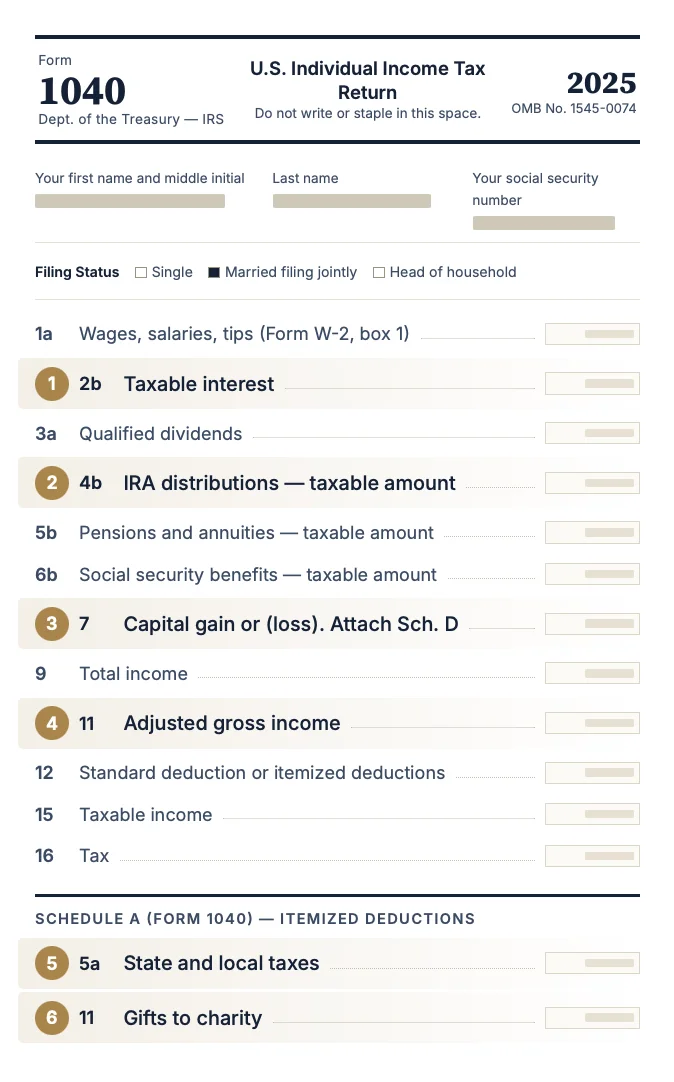
THE CENTERPIECE OF OUR PROCESSMost advisors have never read their clients’ tax returns. We read yours line by line — because the strategy is already in there, waiting to be noticed. A few of the places we look first. (You’ll meet all five steps of our process below — this is the one that sets us apart.)
Interest taxed at your highest rate
LINE 2B — TAXABLE INTERESTHigh-yield savings sitting in a taxable account gets taxed as ordinary income, every year. Often that cash belongs somewhere else — and what’s in the tax-deferred account belongs where the growth is.
Is there a conversion window hiding here?
LINE 4B — IRA DISTRIBUTIONSA lower-income year is an opportunity that expires December 31. We project your bracket before year-end and convert only the amount that fits — instead of discussing Roth conversions in theory, forever.
Capital Gains
LINE 7 — CAPITAL GAINSThis line tells us whether gains and losses are being harvested deliberately — timed to your bracket, your cash needs, and the rest of the plan — or just happening to you.
The number behind the numbers
LINE 11 — ADJUSTED GROSS INCOMEAGI quietly drives your Medicare premiums, deduction floors, and credit phase-outs. Managing it is one of the highest-leverage moves in the return — and one of the least discussed.
A $40,000 cap changes the timing math
SCHEDULE A — STATE & LOCAL TAXESWith the SALT deduction cap now $40,000, when you pay matters. Paying your January state estimate in December can pull the deduction into the year it helps most — a move most preparers never mention.
Deducted, but not timed
SCHEDULE A — CHARITABLE GIVINGGiving the same amount every year may waste the deduction. Bunching gifts, using appreciated stock, or a Qualified Charitable Distribution after 70½ can turn the same generosity into a much better tax result.
If nobody has ever walked you through your own return like this — that’s the gap we were built to close.
From scattered accounts to one coordinated plan
THE FIVE STEPSWe don’t start with a product. We start with where you want your life to go — and the tax and investment decisions that either move you toward it or quietly hold you back.
Click any step on the wheel to explore it.
We get clear on where you're headed — not just what you own
Before we talk numbers, we get specific about your goals and sort them by time frame and priority. Retirement, a second home, a business exit, the legacy you want to leave — each one carries different tax and investment implications.
Most advisors start with your money. We start with your life — then build the plan around it.
We read your tax return the way most advisors never do
Your return is the most complete picture of your financial life — income sources, investment income, business interests, charitable behavior, missed opportunities. We read it line by line, looking for what's costing you and what could be working harder. You saw a sample above; yours will have its own findings.
Most people have a CPA who files the return and an advisor who's never read it. Here, one team prepares the return and manages the investments — so nothing falls through the gap.
We map the moves — and when to make them
Which accounts should hold which investments. Whether a Roth conversion makes sense this year — and how much. When to realize gains, when to give, when to wait. You'll see every trade-off in plain language, with the tax cost attached, before a single decision is made.
The difference between a good year and a great one is usually timing — and timing is a decision, not luck.
We put the plan to work — and keep it consistent
We implement within a disciplined framework, so every account, every position, and every tax move stays aligned with the goals from step one. No drifting, no decisions made in isolation.
A plan that only works on paper isn't a plan. We build yours to hold up when life doesn't cooperate.
We adjust as your life — and the tax code — change
Income shifts, markets move, tax laws change, and life delivers the unexpected. We revisit your strategy throughout the year and adjust before a problem becomes a tax bill.
The relationship doesn't end in April. That's usually when the real work starts.
Where most planning stops.
Ours keeps going.
A YEAR WITH USApril 15 is a deadline, not a finish line. Here’s what the calendar actually looks like when your tax strategy and investments are managed together.
File — and read
JAN — APRWe prepare your return in-house, and study it as we go. Filing season is our best research season.
The strategy review
MAY — JUNFresh off your return, we meet to turn findings into this year’s plan — while most firms are locking the office.
Mid-year projection
JUL — SEPWe project your income and bracket for the year. This is where conversion windows and timing decisions get sized.
Year-end execution
OCT — DECHarvesting gains or losses, charitable moves, RMDs and QCDs, final conversions — done deliberately, before the window closes.
When tax season ends for most firms, the real planning work begins for ours.
This process is built for households with $500,000 or more in investable assets — and the desire to have them managed in coordination with their tax strategy.
WHO THIS IS BUILT FORIf that’s you, the thirty minutes will be time well spent. Our clients tend to be people with real complexity — retirement accounts, taxable portfolios, business interests, inherited wealth — who’d rather have one coordinated plan than two professionals who’ve never compared notes.
Looking for tax preparation on its own? We’re happy to point you toward a great option.
Thirty minutes to know if we’re the right fit
No pressure, no sales pitch. We’ll look at how your taxes and investments are working together today — and whether this process would make a difference for you.